Forces
Use the commands in the Forces menu and toolbar to add, calculate, and measure kinetostatic forces*.
In MechDesigner, to calculate the Forces that act on Parts correctly:
•the kinematic-chain must be kinematically-defined
•a minimum of one Part in the kinematic-chain has Mass, and usually a Mass Moment of Inertia - see Mass Properties, below
•the power flows through the kinematic-chain from the correct Power Source - see Configure Power Source.
* We use the term Force to mean Force and/or Torque.
Mass Properties
We use the term “Mass Properties” for Mass and Mass Moment of Inertia . Each Part in your model has three sources for its Mass-Properties: •Profile / Extrusions - see Extrusion > Mass Properties •User Mass Properties - see CAD-Line > Mass Properties tab > User Mass Properties •SolidWorks Mass Properties - see CAD-Line > Mass Properties tab > SOLIDWORKS Mass Properties We add the three. Note:
|
 On-line Tutorial: Tutorial 13: Forces Introduction
Force menu

Forces menu (MD17)
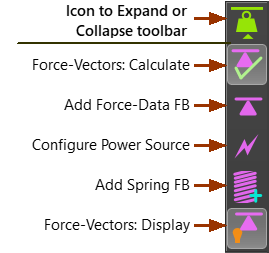
Force toolbar
The Force toolbar is to the right of the graphics-area.
Buttons to Scale Force and Torque Vectors in the graphics-area.
If, after you display Force Vectors, (Force and Torque) the arrowheads of the vectors are outside of the graphics-area, you must use the Scale buttons to decrease the length of the Force Vectors and/or Torque Vectors - see Feedback Area > Vector Scaling buttons
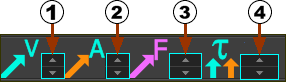
Vector scaling
F: Force Vectors, T: Torque Vectors
Definitions from IFTOMM International Federation on the Theory of Machines and Mechansims
Force definitions
FORCE |
|---|
Action of its surroundings on a body tending to change its state of rest or motion. |
LINE OF ACTION OF A FORCE |
The line along which the vector that represents a given force lies. |
MAGNITUDE OF A FORCE |
Number of units of force obtained by comparing a given force with a standard, taken as unit force -(SI units : Newtons) |
ACTIVE [APPLIED] FORCE |
Force capable of producing motion. |
REACTION |
Force arising in a constraint and acting upon a constrained body due to the action of an active force upon that body. |
CENTRIPETAL FORCE |
Force causing the centripetal acceleration of a particle. |
INERTIA FORCE |
Product of the mass of a particle and the negative of its acceleration. Following D'Alembert, the inertia force can be regarded as being in equilibrium with the resultant of all the forces acting on the particle. |
CENTRIFUGAL FORCE |
Inertia force of a particle moving uniformly along a circular path. |
CORIOLIS FORCE |
Inertia force equal to the product of the mass of a particle and the negative of its Coriolis component of acceleration. |
GRAVITATIONAL FORCE |
Force equal to the product of the mass of a particle and the Gravitational Acceleration on Earth - taken as 9.806m/s/s. |
Acceleration Definitions:
We calculate for you those Forces that result from these Accelerations :
CORIOLIS ACCELERATION |
|---|
Component of the absolute acceleration of a point due to its velocity relative to a rotating frame of reference. It equals twice the vector product of the angular velocity of the moving frame of reference and the relative velocity of the given moving point. |
CENTRIPETAL ACCELERATION |
Acceleration of a point towards the center of curvature of its path as it moves along a fixed curve. |
TANGENTIAL ACCELERATION |
Component of acceleration of a point collinear with its velocity. |
NORMAL ACCELERATION |
Component of acceleration of a point normal to its velocity. |
ANGULAR ACCELERATION |
Rate of change of angular velocity with respect to time. |