It is not necessary to connect wires to the input-connector or from the output-connectors of the Spring FB. However, the input and output-connectors provide extra functionality - see here
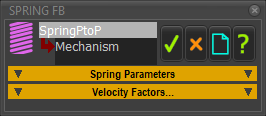
The Spring dialog is now open.
Spring dialog
Spring FB dialog
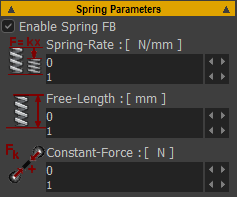
Spring Parameters
☑ Select the check-box to enable the Spring FB.
Spring-Rate [N/mm] :
Force Contribution:
= Spring-Rate × |Spring-Length – Free-Length |
Spring-Length is the distance between the two anchor-points.
The Force always acts on the anchor-points to attempt to return the Spring to its Free-Length
Note:
Do not enter a negative Spring-Rate (In a new release, we will make sure you cannot enter a negative number).
Free-Length [mm] :
The natural length of the Spring when it is not joined to the Anchor-Points.
Constant-Force [N]
A positive Constant-ForcePULLS the Anchor-PointsIN (o>>> + <<<o)
A negative Constant-ForcePUSHES theAnchor-Points OUT (o<<< — >>>o)
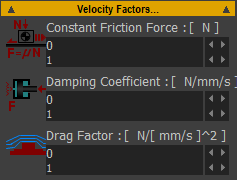
Velocity Parameters
Coulomb (Constant) Friction Force
A pseudo constant force that is opposite to the direction of the motion.
In a kinetostatic force analysis, it is only an approximate of the Friction-Force.
Note:
The Friction-Force between two bodies in contact at a joint is proportional (approximately) to the force that acts on the bodies at the joint.
However, because the force acting between the two bodies is usually not constant, the Friction Force is also, in reality, NOT constant.
Viscous Coefficient ( )
A Force that is proportional to the velocity between the Anchor-Points.
The direction of the force is opposite to the velocity between the Anchor-Points.
For example, if theDamping Coefficient = 4 and the Velocity is +100mm/s, (anchor points moving away from each other), the force pulling the points together is a force of 400N.
Drag Factor ( )
A Force that is proportional to square of the velocity between the Anchor-Points. For example, air resistance.
The direction of the force is opposite to the velocity between the Anchor-Points.
For example, if theDrag Factor = 4, and the Velocity = +100mm/s (anchor-points are moving apart), then the force pulling the anchor-points together is a force of 40000N.
Input and output-Connectors
Output-Connectors
The Spring-FB has two output-connectors.
Top :
Distance, Velocity, Acceleration of the dimension between the anchor-points.
Bottom :
Total Force exerted by the Spring
Force-X (force parallel with the X-axis of the Mechanism-Editor), and
Force-Y (force parallel with the Y-axis of the Mechanism-Editor) acting on anchor-points.
or
Driving-Force = Linear Motive Force, if you configure the Spring FB as a Linear Motor - see Configure Power Source
Input-Connector
The Spring-FB has one input-connector.
To add a Force-Function to the Total-Force, connect a wire to the input-connector of a Spring FB.
The units of the data at the input-connector must be units of Force to give Newtons.
Usually, use a Math FB to convert the data-type to Force.
For example: to convert to , you must:
1.Add a Math FB to the graphics-area
2.Connect a wire to the input-connector of the Math FB from a Function-Block that measures a distance, e.g. from a Measurement FB constant or variable.