Quadratic Motion-Law

<< Click to Display Table of Contents >>

Navigation:  MotionDesigner Reference & User Interface > Motion Laws / Cam-Laws for Segments >

Quadratic Motion-Law

Quadratic Cam-Law, Motion-Law

Motion Description

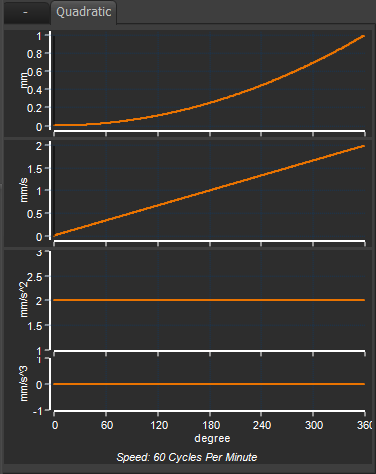
A Traditional Motion-Law. This is a Polynomial motion-law.

Velocity can linearly increase or decrease, or Velocity can be constant.

Acceleration is constant.

Jerk is zero.


Note:

Generally, the Acceleration is not zero at its start and end. Therefore, we would recommend the Flexible-Polynomial motion-law for the Previous-Segment and Next-Segment as it can match the non-zero, constant acceleration at the start and end of the Quadratic motion-law.

Motion-Values

You CAN control the:

Start Position

The Start-Position usually flows from the End-Position of the Previous-Segment.

End Position

Start Velocity

The Start-Velocity usually flows from the End-Velocity of the Previous-Segment

You CANNOT control the:

End Velocity

Start Acceleration and End Acceleration

Start Jerk and End Jerk

Segment Parameters

None

Segment-Range

None

Quadratic Motion-Law

Quadratic Motion-Law

In the image above of 1 Quadratic segment, the motion-values are:

Start Position = 0mm

End Position = 1mm

Start Velocity = 0mm/s

Applications

Motion segment with Constant Acceleration, or Linearly Increasing or Decreasing Velocity.

You can use a Quadratic motion-law to model a Part under the influence of a constant acceleration (e.g gravity), or a constant force or torque.

Note:

You can also use a Flexible-Polynomial as a Quadratic (Constant-Acceleration) motion-law.