Intel graphics-cards do NOT (usually) work with MechDesigner. |
Symptoms
You experience:
•The model does not Cycle(Run menu> Cycle), or the graphics view is very slow to respond when you use your mouse to Zoom-In or Zoom-Out.
•When you move your mouse onto the graphics-area, MechDesigner selects everything all the time!
•MechDesigner freezes.
Cause - usually
The integrated Intel video card option is being used and not the AMD or NVIDIA video card option that offers better performance.
Solutions:
Most of the following information has been copied - more or less word for word - from https://www.dell.com/support/kbdoc/en-uk/000190229/how-to-set-nvidia-video-as-the-default-with-computers-that-have-integrated-and-discrete-video-cards
It is their copyright.
Does my Laptop have Switchable Graphics?
Not every computer has more than one graphics card. Desktops with a single discrete graphics card don't need it, since there's nothing to switch between.
Here's the fastest way to check:
1.Press Windows key + X, then select Device Manager.
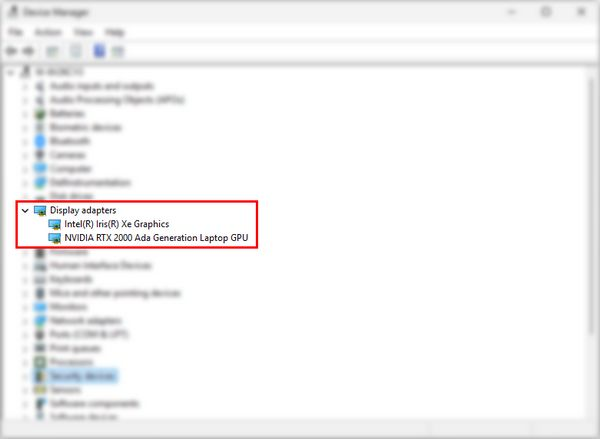
2.Expand Display adapters - see image below
3.If you see two entries — for example, Intel(R) UHD Graphics and NVIDIA (or an AMD Radeon card), your laptop supports switchable graphics.
If you only see one entry, your laptop has a single GPU, and the notes below do not apply to your system.
Note for Desktops
Unlike laptops, desktops do not switch GPUs automatically for each app. Instead, whichever port your monitor cable is plugged into determines which GPU is used. If your monitor is connected to the discrete graphics card's port, your computer uses only the discrete GPU, the integrated GPU isn't available at the same time. To use the integrated GPU instead, move your monitor cable to the video output port on the motherboard. |
How do I check which GPU is currently being used?
Before changing any settings, confirm which GPU an app is actually using.
1.Open the app or game you want to check.
2.Press Ctrl + Shift + Esc keys on your keyboard to open the Task Manager.
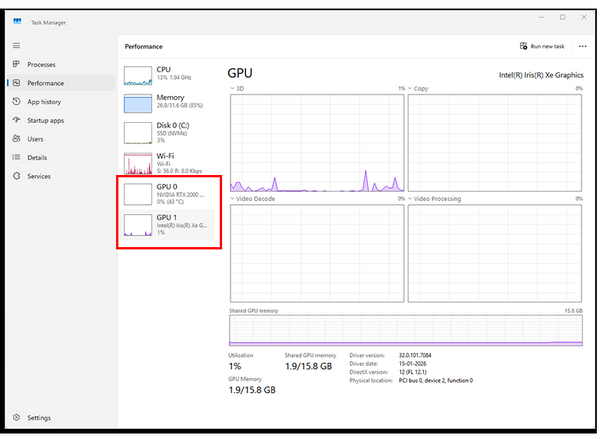
3.Select the Performance tab. Each GPU is shown as a separate tile, with its number (GPU 0, GPU 1) as the heading and the card's name underneath it. For example, GPU 0 followed by NVIDIA RTX 2000 Ada Generation Laptop GPU, and GPU 1 followed by Intel(R) Iris(R) Xe Graphics. Note which number belongs to which card.
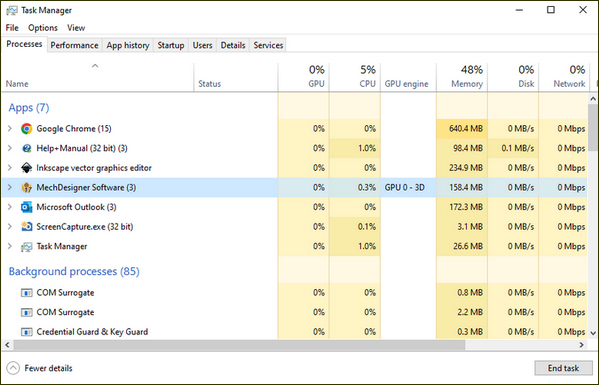
4.Switch to the Processes tab. The GPU and GPU Engine columns aren't shown by default, so right-click any column header (for example, CPU or Memory) and select GPU and GPU Engine to add them. It may help to drag the GPU and GPU-Engine headers to the left. - see image below.
5.Find your app in the list. The GPU column shows how much of that GPU's capacity the app is using, as a percentage. The GPU Engine column shows which GPU number and engine the app is using right now (for example, GPU 1 - 3D).
6.Match the GPU number shown in GPU Engine back to the name you noted in the Performance tab in step 3, to confirm which physical graphics card the app is actually using.
A few things to keep in mind:
•The GPU column is a percentage, not a name. Use it to see how busy the GPU is, not which GPU it is. •The GPU number can vary by system. Windows assigns GPU 0 and GPU 1 based on driver enumeration order. This isn't always consistent between laptops, so always confirm the mapping using the Performance tab rather than assuming GPU 0 is your discrete card. •A blank GPU Engine value is normal. It just means the app isn't actively using the GPU at that exact moment, the value updates continuously as the app renders. •If you only see one GPU listed in the Performance tab even though Device Manager shows two, that's expected too. Reopen the app you're testing and check again, since usage tiles can take a moment to reflect activity. |
Integrated and Discrete Video - General Information
Laptops
Laptops frequently have two built in Graphic Processing Units (GPU).
The primary is the Intel integrated GPU (built in the processor) and the second is the discrete AMD or NVIDIA GPU.
The purpose of having two GPUs is to extend battery life in laptops and to have better graphic performance for gaming, programming, CAD, ... .
The best example is when using the laptop on battery, the integrated Intel GPU is used since it uses less power. But if the laptop is plugged in and you want to use the laptop for gaming, the discrete GPU would be used for better performance.
Desktops
Desktops also may have the option to add a discrete video card for better video performance (games, 4K video, and so forth). When an external monitor is connected to this discrete video card, there is no option to use the integrated Intel GPU.
Default Graphics Card Settings
By default, Windows defines the best GPU for each application based on preloaded profiles. Applications with specific GPU requirements show a Lock icon beside the application name and cannot be changed. These applications always run on the Integrated GPU (Power-Saving Mode).
Configuring NVIDIA Switchable Graphics
Always Use NVIDIA Video
Do these steps to set the NVIDIA video card as the default video option.
1.Open the NVIDIA Control Panel.
2.Click 3D Settings > Manage 3D Settings

Click to Expand:
NVIDIA Control Panel - Manage 3D Settings
3.Click the Program Settings tab.
4.On the Global Settings tab, locate and select the Preferred Graphics Processor option. From the list, select High-performance NVIDIA Processor

Click to expand: NVIDIA Control Panel, Preferred Graphics Processor
5.Click Apply.
Note:
•You can also add programs individually, using the drop-down option.
Configuring AMD Radeon Switchable Graphics
Manual Configuration
The following steps can be used to set the AMD video card as the default video option.
1.Right Click on the desktop
2.Click AMD Radeon Settings from the menu
3.Click on System

Click to expand
AMD Radeon Settings
4.Click on Switchable Graphics

Click to expand:
AMD Radeo Settings > Swichable Graphics
In the Switchable Graphics menu, the Running Applications view is displayed by default. This view lists recent and current running applications and their assigned Switchable Graphics mode.
For applications that are not locked by Windows, the following Switchable Graphics modes can be selected from the application drop-down menu:
•Power Saving - Selects the integrated GPU, which consumes less power but provides lower performance.
•High Performance - Selects the discrete GPU, which consumes more power but provides better performance
•Based on Power Source - Selects the integrated GPU when running on battery and selects the discrete GPU when plugged into a power outlet.
Select a desired mode for the application and the change will take effect the next time the application is loaded.
If an application is not on the list, do the following:
1.Right Click on the desktop.
2.Click AMD Radeon Settings from the menu.
3.Click on System.
4.Click on Switchable Graphics.
5.Click on the Running Applications option and select Installed Profile Applications to view all applications detected by the graphics driver

Click to expand:
AMD Radeon Settings, Switchable Graphics Profiles
6.If the application is not listed, use the Browse option to locate and add the application to the list.
More information about: How to Configure Laptop Switchable Graphics